A Drop in Boiler Pressure Can Cost More Than You Think
For a manufacturing company, an unexpected boiler pressure drop can affect much more than the boiler itself.
When pressure falls below the required operating range, production processes can become inconsistent, affecting product quality. If the issue continues, production may eventually have to stop, leaving machines and workers idle and causing further delays and costs.
There is also the hidden cost of recovering the pressure.
When pressure starts dropping, workers may increase fuel consumption in an attempt to bring it back up faster. But pressure does not necessarily recover proportionally to the additional fuel being used. This can lead to unnecessary fuel consumption and higher operating costs while the system is still taking time to reach the required pressure.
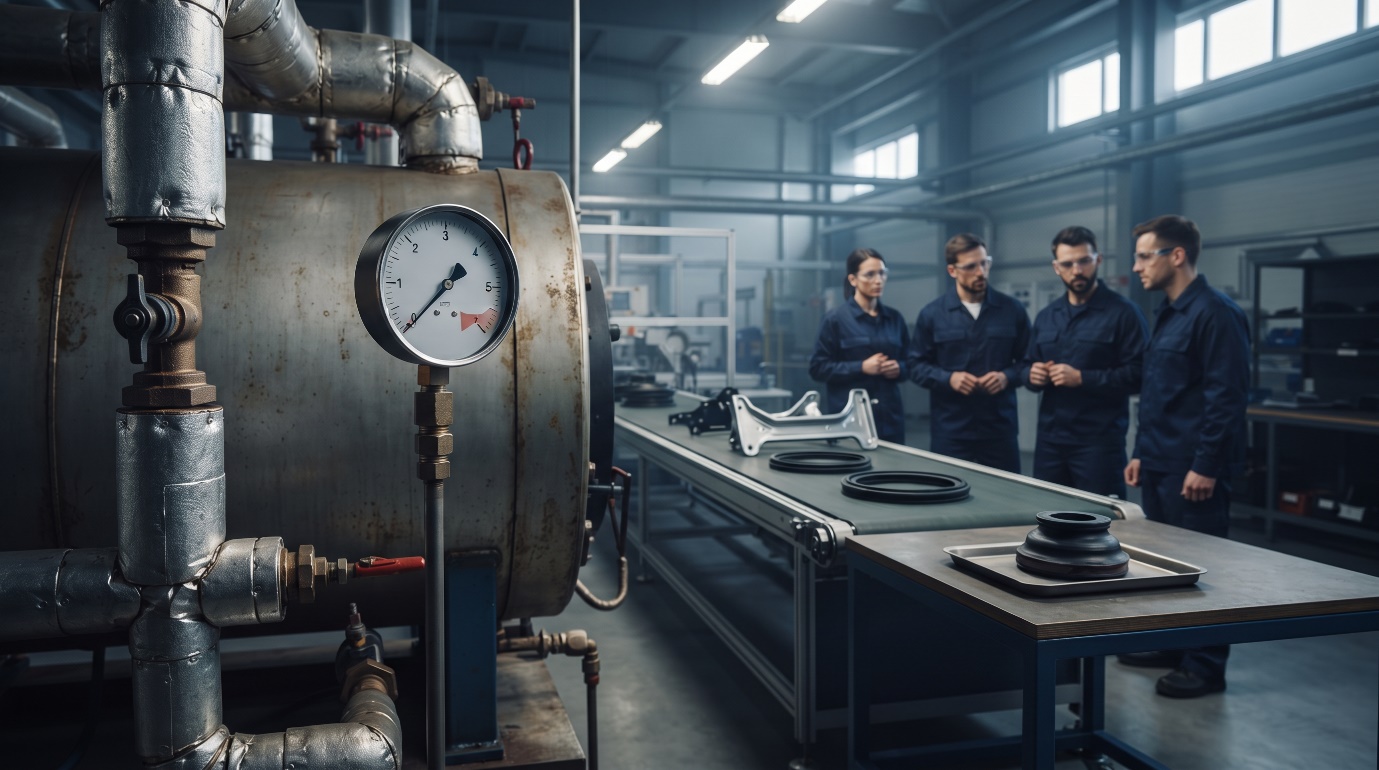
The Problem: Manual Monitoring
Previously, a worker had to manually monitor the boiler gauge and keep an eye on its pressure throughout production.
The problem is simple: a person cannot continuously watch a gauge every second of every production shift.
A pressure deviation can therefore go unnoticed until it has already started affecting the process.
One manufacturing company was experiencing approximately 3–4 boiler-related production outages every month. More importantly, periods of low boiler pressure were affecting the consistency and quality of their products.
We automated their boiler monitoring using AI ON EDGE Automated Gauge and Utility Monitoring feature.
There was no need to replace their existing analogue gauge or install proprietary monitoring hardware. We used their existing camera to continuously monitor the existing gauge, while AI interpreted the gauge readings.
But the system wasn't designed to simply alert the team after the pressure had already reached a critical level.
We configured early-warning thresholds so the responsible team could be alerted before the pressure reached the critical limit.
For example, if the critical pressure limit is 100, the system can be configured to issue an early warning around 90, giving the team time to investigate and take corrective action.
The goal isn't to tell you that the pressure has already reached a critical level.
The goal is to give your team time to act before it affects production.
The Results
After automating the monitoring process:
- 3–4 monthly boiler-related outages comes down to 0
- 3–4% improvement in fuel efficiency
The company moved from periodic manual gauge checks to continuous automated monitoring with early warnings.
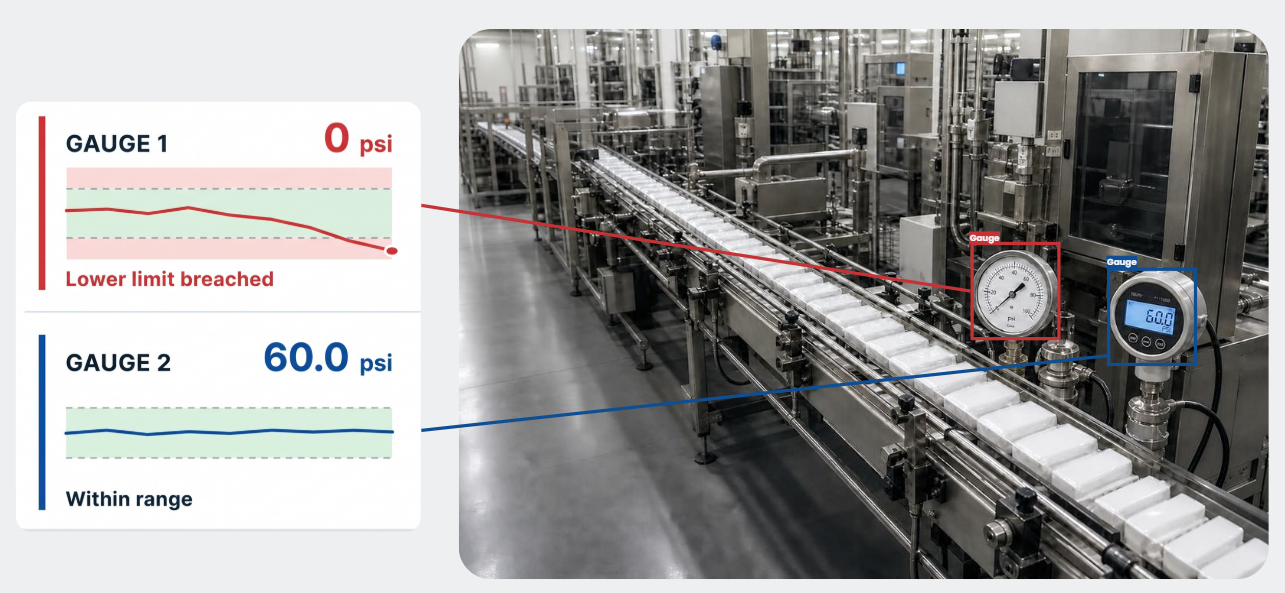
The system continuously records pressure readings, monitors the defined operating range, and alerts the responsible team when pressure begins approaching a critical threshold.
This helped the company respond earlier, reduce unnecessary fuel consumption, and prevent pressure-related disruptions from affecting production.
From Manual Checks to Continuous Monitoring
This is the value of AI ON EDGE.
You don't necessarily need to replace your existing gauges or build an entirely new monitoring infrastructure. Existing cameras can observe existing analogue gauges and AI can convert those visual readings into useful operational information.
Could Your Factory Benefit From Automated Monitoring?
If your manufacturing facility relies on boilers, machinery, analogue gauges, or manual monitoring, AI ON EDGE can help you turn that existing infrastructure into a smarter, continuously monitored system.
Let's identify where AI can make a measurable difference in your operations.
Contact: info@aionedge.ai
Keywords: AI boiler monitoring, automated gauge monitoring, boiler pressure monitoring, industrial AI, manufacturing utility monitoring, preventive maintenance, on-site edge AI, existing camera monitoring, fuel efficiency, production continuity, industrial insights, AI ON EDGE, industrial AI Pakistan, industrial AI Saudi Arabia, GCC industrial automation.